

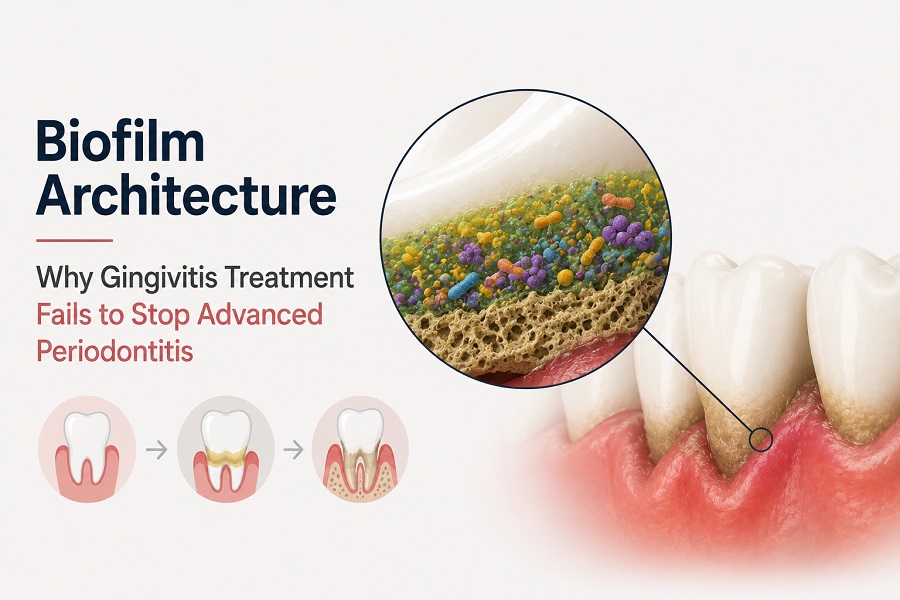
In the clinical study of oral health, the transition from a reversible inflammatory condition to a chronic, destructive disease is defined by a shift in microbial geography. While both gingivitis and periodontitis are caused by dental plaque, the “architecture” of the bacteria involved—and where that bacteria resides—changes fundamentally as the disease progresses.
Patients often feel frustrated when standard hygiene practices that once successfully managed “bleeding gums” suddenly fail to halt the progression of bone loss. The reason lies in the physical and biological complexity of the periodontal pocket. Understanding why standard gingivitis treatment is insufficient for periodontitis is the first step in adopting a more advanced, clinically targeted intervention.
The Anatomy of Biofilm: From Surface Plaque to Subgingival Fortresses
To understand the failure of standard treatments, one must first understand the nature of dental biofilm. Plaque is not merely a random collection of bacteria; it is a highly organized “city” of microorganisms encased in a protective extracellular matrix.
1. The Supragingival Biofilm (Gingivitis Zone)
In the early stages of gingivitis, the biofilm accumulates on the visible surfaces of the teeth and along the gum line (supragingival). These bacteria are primarily aerobic, meaning they require oxygen to survive. Because they sit on the surface, they are easily disrupted by the mechanical action of a toothbrush or the chemical reach of a standard mouthwash.
2. The Subgingival Biofilm (Periodontitis Zone)
As gingivitis remains untreated, the gums become inflamed and lose their tight “collar” around the tooth. This creates a space called a periodontal pocket. Bacteria migrate into this oxygen-depleted environment, evolving into anaerobic species. These microbes are significantly more aggressive and produce potent toxins that trigger the body’s immune system to break down its own bone and connective tissue.
Why Gingivitis Treatments Fall Short
Standard treatments for gingivitis—which typically include twice-daily brushing, flossing, and cosmetic rinsing—focus on the “crown” of the tooth. When a patient develops periodontitis, these methods fail for several structural reasons:
1. The Depth Barrier
A standard toothbrush bristle can only reach about 1–2 millimeters below the gum line. In a healthy mouth or a mouth with mild gingivitis, this is sufficient. However, in periodontitis, pockets often reach depths of 5mm, 7mm, or more. Brushing the “top” of a 7mm pocket leaves the most destructive bacteria at the bottom completely undisturbed. They continue to multiply and dissolve the jawbone, even if the “visible” part of the tooth looks clean.
2. The Anaerobic Shift
The bacteria driving periodontitis (such as Porphyromonas gingivalis) are biologically different from those in gingivitis. They are “asaccharolytic,” meaning they break down proteins (from blood and gum tissue) rather than sugars. Standard oral care products designed to neutralize food acids are often ineffective against the alkaline-byproducts and protein-destroying enzymes produced by these deep-pocket pathogens.
3. Mineralization and Calculus
In the deep, stagnant environment of a periodontal pocket, plaque rapidly mineralizes into tartar (calculus). This stony substance has a rough, porous surface that acts as a “scaffold” for more bacteria. Once tartar forms deep under the gum line, no amount of brushing or flossing can remove it. It requires professional “Scaling and Root Planing” (SRP) to physically scrape the root surfaces clean.
The Role of Advanced Chemical Debridement
Because mechanical cleaning has physical limits in deep pockets, the role of chemical intervention becomes paramount. However, not all rinses are created equal when moving from gingivitis to periodontitis management.
Fluid Dynamics and Biofilm Penetration
A therapeutic, antimicrobial mouthwash provides a unique advantage: fluid dynamics. While a brush is a solid object that is blocked by the gum margin, a liquid can—to a limited extent—penetrate the upper layers of a pocket.
-
Reducing the “Bacterial Load”: By killing the bacteria at the “entrance” of the pocket, a rinse prevents more microbes from migrating deeper.
-
Neutralizing Toxins: Antimicrobial agents can neutralize the inflammatory toxins (lipopolysaccharides) produced by the biofilm, slowing down the body’s urge to dissolve bone.
-
Altering the Micro-environment: Regular use of an oxygenating or antimicrobial rinse makes the pocket environment less hospitable for anaerobic bacteria.
Clinical Management: The “Scaling” Bridge
If you have transitioned from gingivitis to periodontitis, your treatment plan must escalate.
-
Professional Debridement: You must have the “subgingival” tartar removed by a professional. This “resets” the pocket and allows the gums a chance to reattach to the tooth.
-
Chemical Maintenance: Following a deep cleaning, the use of a high-quality antimicrobial mouthwash is essential to prevent the “re-colonization” of the pockets. Without this chemical shield, the aggressive bacteria can return to the bottom of the pocket within weeks.
-
Frequent Monitoring: Periodontitis is a chronic condition. While gingivitis can be “cured,” periodontitis must be “managed” through more frequent cleanings (often every three months) to ensure the biofilm architecture does not reform its destructive deep-water fortresses.
Conclusion: Changing the Strategy
The failure to stop periodontitis using gingivitis methods is not a failure of effort, but a failure of geography. Once the bacteria move into the deep, dark, and oxygen-free zones of the periodontal pocket, the “rules” of oral hygiene change.
To save your teeth and protect your systemic health, you must bridge the gap between mechanical brushing and deep-reaching chemical protection. By combining professional scaling with the daily use of a therapeutic mouthwash, you can disrupt the biofilm architecture, collapse the pockets, and stop the “silent” destruction of your smile. Understanding the depth of the problem is the only way to ensure the longevity of your oral health.
